
Attractions
Fraser River and Thompson River Attractions |
||||
|
||||
|
|
||||
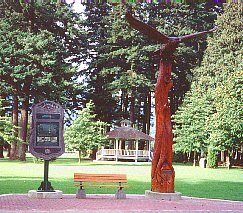
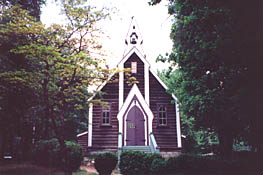
Hope is located at the south end of the Fraser Canyon. The Hope Museum, on Water Avenue has displays featuring artifacts from the gold rush era. Hope's Christ Church, built in the late 1850's, is still on the original site. There is also the Othello Tunnels and the Chainsaw Carvings.
|
||||
|
|
||||
Yale Museum, offers a great insight of the gold rush era, also has displays of railway history and Aboriginal artifacts. St. John the Divine Anglican Church, built in the early 1860's by the Royal Engineers, is one of the oldest churches in B.C. on it's original foundation. The Cariboo Wagon Road Monument, the Barnard's Express Commemorative Plaque and the Chinese Railway Workers Monument are all located on Front Street. Take the historic walking tour that includes the Pioneer Cemetery. |
||||
|
|
||||
|
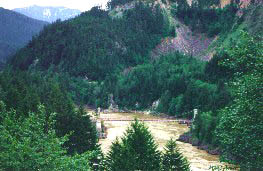
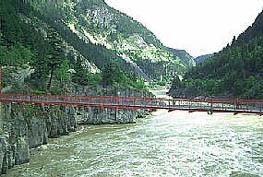
The first bridge was built in 1863 by John W. Trutch. He used wooden towers and wire woven at the site. It was so well constructed that not one thread snapped. This was the first suspension bridge in the west and was named for Alexandra, Princess of Wales, who later became the Queen of Edward V11. The second bridge, built in 1926, was similar in design and used the same footings as the original bridge and is now part of the Alexandra Bridge Provincial Park. You can see the original bridge from the park, and to the east you can see where the original road was located. This is a day picnic park only, and a great place to stop and have a good look at the Fraser River, the Canyon and to try and imagine just what the explorers, miners and construction workers had to endure.
You
cross the Fraser River on the latest Alexandra Bridge that was
erected in 1962, where you will find a cairn that commemorates
the work of the Royal Engineers, who played a large role in the
original construction of the "wagon road." |
||||
|
|
||||
|
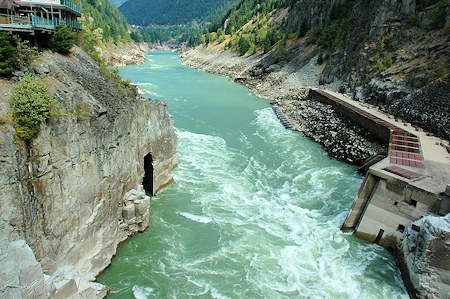
Hell's Gate This is where the Fraser River was finally able to breach the mountains and make an outlet that would take it all the way to the Pacific Ocean. The gorge is only 35 metres (115 feet) wide, but is 25 metres (82 feet) deep at low water and can be as deep as 50 metres (165 feet) or more during spring and summer run-off. The river is so narrow and wild that it can stop the salmon from heading up river to their spawning grounds. In order to preserve the salmon that came up the river, a Fishway was started in 1944 and completed two years later. The Hell's Gate Fishways Viewpoint explains how this section has been a hardship on transportation. There are 8 Fishways in total. In
1808, Simon Fraser, the first European to see and explore this
region was sure that this gorge on the river resembled "the gates
of hell." Fraser and his men crept on hands and knees and clung
to the bark ladders that the aboriginals built and used in order
to make their way through Hell's Gate. Today you can view the
gorge and the fishways by the aerial tramway that crosses the
Fraser River.
Hells Gate Airtram - Famous Hell's Gate Airtram in the scenic Fraser Canyon is nature at its most magnificent. Descent smoothly from highway level in one of two comfortable 25-passenger gondolas. Experience a breathtaking view of the Fraser River, Hell's Gate, and the International Fishways. |
||||
|
|
||||
The Aerial Ferry, was at one time the only way across the Fraser River to North Bend. |
||||
|
|
||||
|
Located north of Boston Bar, it commemorates the mules that toiled carrying supplies up and down the steep slopes along the canyon walls. |
||||
|
|
||||
Lytton Go for a short trip on the reaction ferry that uses the power of the current to propel the craft across the river. The Lytton "Jellyroll" a conglomeration of silt, sand and gravel formed at the end of the last Ice Age. |
||||
|
|
||||
Lillooet In Lillooet, the Mile 0 Cairn, marks the start of the first Cariboo Road. It is just one of the many historic sites you will find along the streets, as you do a walking tour of the town. See the Hangman's Tree, where in the 1860's "Hanging" Judge Matthew Begbie handed out justice. There are some 350 Upper Lillooet Native Archeological Sites, in the vicinity. |
||||
|
|
||||
Spences Bridge When the steelhead are running, you will see numerous people fishing right off the bridge. In the spring and fall, you can often see big horn sheep grazing on the grass within the Spences Bridge town limits. |
||||
|
|
||||
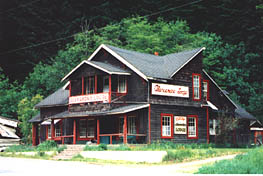
Ashcroft Ashcroft Museum, located in the 1917 post office at Fourth and Brink Streets has displays that represent the railway, ranching, mining, farming, Chinese and Aboriginal history. Ashcroft Manor, has been restored and is now a Tea House and Gift Shop. It's located south of the Ashcroft turn off on the Trans Canada Highway. |
||||
|
|
||||
Cache Creek Located at the junction of Hwy 97 North which takes you into the Cariboo Chilcotin Region, and the Trans Canada Hwy. # 1 that heads east to Kamloops and beyond, this community has for many years been the halfway point for people traveling from Hope into the interior of B.C. This is cattle country and a great place for rock hounding, especially for people looking for jade. Just before you reach Cache Creek, you will see the turn off to Ashcroft., which is only 6 km ( 4 mi.) from Highway 1. |
© 1996- INTERACTIVE BROADCASTING CORPORATION
Attractions on the Fraser River, Fraser Canyon, Thompson River, Thompson Canyon