Wilderness
Survival: Food & Water
FINDING
FOOD & WATER
In
a wilderness survival situation, it is possible to
live for extended periods of time on little or no
food. Research shows that a healthy individual can
survive on 500 calories a day with no side effects
and with plenty of water and a comfortable resting
place can live approximately three weeks without food.
During cold weather or periods of heightened activity
more food is required to maintain a normal body temperature.
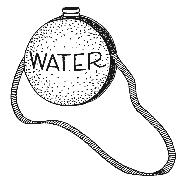 Water
is much more important. Two to three cups of water
are required each day to stay healthy. It is wise
to conserve the water in your body by reducing activities
that may promote water loss. Water
is much more important. Two to three cups of water
are required each day to stay healthy. It is wise
to conserve the water in your body by reducing activities
that may promote water loss.
Finding
water during the summer months is quite
easy. Running water such as springs or streams in
isolated areas is generally safe for consumption but
be aware that water in stagnant areas such as sloughs
and ponds may carry disease and should either be boiled
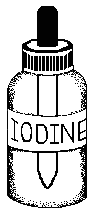
for a minimum of three minutes, or iodine (nine drops
per quart) or halazone tablets added.
 It
is wise to carry a water purification pump with you.
This allows the hiker to make use of stagnant water
in any situation and it is not necessary to carry
water with you. In areas where no surface water is
available, dig into damp soil and allow this muddy
water to settle and become clear. Water may also be
found on the dew of plants, by collecting rainwater
or in fish juices. It
is wise to carry a water purification pump with you.
This allows the hiker to make use of stagnant water
in any situation and it is not necessary to carry
water with you. In areas where no surface water is
available, dig into damp soil and allow this muddy
water to settle and become clear. Water may also be
found on the dew of plants, by collecting rainwater
or in fish juices.
During
the winter months it is wise to look for water under
ice. Melting ice as opposed to snow is more fuel efficient.
Remember that hard-packed snow will yield more water
than light, fluffy snow. Do not eat snow as it tends
to dehydrate the body.
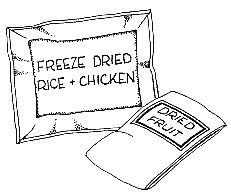 Finding
food in the wilderness may prove slightly
more difficult but by no means impossible. Try and
sustain with natural foods before using your emergency
survival kit rations. Finding
food in the wilderness may prove slightly
more difficult but by no means impossible. Try and
sustain with natural foods before using your emergency
survival kit rations.
If
water is not readily available try to limit your food
consumption to carbohydrates, as proteins use more
water to digest. Keep in mind that all fur-bearing
animals and grass seeds are edible and that there
is more food value in the roots of plants than the
greens.
 Extra
care should be taken when consuming seafood. Try to
avoid mussels during the summer months as they contain
certain toxins which are not present during the winter.
Sea urchins, a prickly purple or green sea creature,
may be consumed by breaking them open and eating the
red or yellow eggs inside. Steam snails, clams and
limpets. Frogs, snakes, lizards and birds are also
edible. Remove the head, entrails and skin before
adding them to the pot. Extra
care should be taken when consuming seafood. Try to
avoid mussels during the summer months as they contain
certain toxins which are not present during the winter.
Sea urchins, a prickly purple or green sea creature,
may be consumed by breaking them open and eating the
red or yellow eggs inside. Steam snails, clams and
limpets. Frogs, snakes, lizards and birds are also
edible. Remove the head, entrails and skin before
adding them to the pot.
POISONOUS
PLANTS
Care
should be taken when consuming any unknown plant in
the wilderness. Avoid red and white berries, and plants
resembling beans, melons and cucumber as they are
often poisonous. There are a large variety of mushroom
species, most are edible but some are extremely dangerous
and should be avoided unless you can positively identify
them. Water hemlock is a particularly poisonous plant
which is found in swampy areas of British Columbia.
It grows up to two meters, with hollow roots and small
white flowers. The dangerous baneberry plant grows
up to one meter tall and produces small white flowers
and white or red berries.
FISHING
& HUNTING
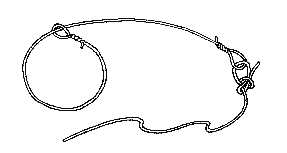 Setting
snares, traps, nets and set lines will assist you
in finding food to help with your survival. Trails
are excellent places to set snares. Animal tracks
offer information pertaining to the type of animal,
its size and the direction it was headed. Following
these tracks will often lead to water-holes and feeding
grounds where you may use your traps or snares. Setting
snares, traps, nets and set lines will assist you
in finding food to help with your survival. Trails
are excellent places to set snares. Animal tracks
offer information pertaining to the type of animal,
its size and the direction it was headed. Following
these tracks will often lead to water-holes and feeding
grounds where you may use your traps or snares.
Before
venturing into the wilderness check weather forecasts
and hazards.
Basic
Survival | Travel
| Food & Water
First Aid & Health
Outdoor
& Survival Training
|